ROME: City of Peter and Paul
by Gary D. Penkala
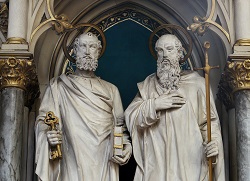 O Roma felix, quæ duorum principum
Es consecrata glorioso sanguine.
Horum cruore purpurata ceteras
Excellis orbis una pulchritudines.
O happy, Rome, by the two Prince's
noble blood your fortune is dedicated to God;
for clad in a robe dyed in purple with their blood,
you far outstrip in beauty all else the world can show.
The Latin text above comes from Verse 3 of the Vespers Hymn, Decora lux, for the Solemnity of Saints Peter and Paul (June 29).
The first two lines appear high on the outside wall of the top floor terrace of the Pontifical North American College, the American seminary in Rome.
Indeed the city draws its nobility from the life and marytrdom of these champions of the early Faith.
Here learn more about them and their lasting presence in the city.
Saint Peter
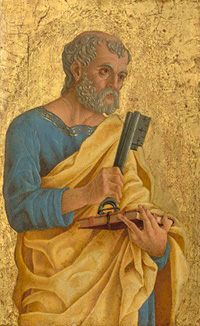 Peter was born Simon in the Galilean village of Bethsaida.
He and his brother Andrew were fishermen by trade.
He was given the name Cephas by the Lord, Aramaic for "rock," translated Petros in Greek, giving us "Peter."
Peter was born Simon in the Galilean village of Bethsaida.
He and his brother Andrew were fishermen by trade.
He was given the name Cephas by the Lord, Aramaic for "rock," translated Petros in Greek, giving us "Peter."
He became one of Christ's closest apostles, along with the brothers James fhe Greater and John.
After the Resurrection and Descent of the Holy Spirit, Saint Peter was instrumental in Jerusalem during the early years of the Church.
He established his first see in Antioch and likely travelled in about 44 AD to Rome, eventually becoming its bishop, hence the first pope.
He was martyred by the Emperor Nero around 64 AD, in the Circus (stadium) of Caligula near the Vatican Hill.
Tradition says he was crucified upside down, not wanting to die as his Master did.
His body was taken by disciples to be buried on the Vatican Hill.
Here are churches dedicated to Saint Peter in the city of Rome:
- Basilica di San Pietro in Vaticano — Saint Peter Basilica at the Vatican.
This is the confirmed burial place of the Apostle Peter, in the Scavi (excavations) beneath the main altar of the basilica.
A basilica, started by Emperor Constantine in 320, covered the burial place of the Apostle on the sloped Vatican Hill.
It could accommodate about 4000 worshipers and stood until 1505, when Pope Julius II began construction of the current basilica.
This Italian High Renaissance structure, the largest church in the world, has numerous famous architects to its credit: Bramante, Michelangelo, Maderno, Bernini, Sangallo, Raphael, della Porta, Fontana.
Many popes are buried here, including Saint Paul VI and Saint John Paul II.
The enormously massive interior houses magnificant artwork: imposing statues and monuments, reliquaries and mosaics (no paintings hang), but all these are surpassed by the Michelangelo masterpiece: the Pietà, housed in the first side chapel on the right.
Respecting earlier tradition, at the crossing of the Latin cruciform building is the main altar, directly over the Confessio containing the bones of Saint Peter.
Crowning this space is a magnificant gilded baldacchino by Bernini over the altar; 95 feet high, but even at that height, fitting (if lifted) into just the small cupola at the top of the monoumental dome, the largest in the world.
So much more could be said, about the tile floor, the mosaics, the piazza and colonnade, the obelisk, the facade, the crypt, the dome.
Save that for another article.
The home and seat of most papal liturgies, Saint Peter's Basilica is not, however, the cathedral of the pope — that is Saint John Lateran.
- San Pietro in Vinculi — Saint Peter in Chains.
This church, on the Esquiline Hill near the Colisseum, houses the chains that bound Saint Peter when he was imprisoned in Jerusalem.
He was miraculously released, as told in Act 12:3-19.
The chains were received as a gift by the Empress Eudoxia (wife of Valentinian III), and her name gives the subtitle Eudoxian Basilica to this church.
The chains binding Peter in the Marmetine Prison in Rome were later added to the relics in this church, housed under the main altar.
This was the church of the influential della Rovere family, in whose lineage Pope Julius II envisioned a massive funeral monument for Saint Peter's Basilica.
Only one statue was completed: the famous Moses, by Michelangelo, housed in this church in the front chapel on the right.
- Cappella di San Pietro in Carcere —Chapel of Saint Peter in Prison.
This chapel, at the foot of the Capitoline Hill near the Roman Forum. is built over the Mamertine Prison, where both Saint Peter and Saint Paul were incarcerated.
Dating from the 7th century BC, This prison, located near the law courts, was used as a holding cell prior to trial and prior to execution.
The crucifix of this small chapel is inverted, owing to the method of Peter's demise.
The Chiesa di San Giuseppe dei Falegnami (Saint Joseph of the Carpenters) is built over this chapel.
- San Pietro in Montorio — Saint Peter Church of the Golden Mountain.
The current church is built on the site of a 9th century church dedicated to Saint Peter, supposedly on the site of his crucifixion.
Until 1797, Raphael's masterpiece, The Transfiguration, decorated the high altar.
The art was expropriated to France during the Napoleonic period, but is currently housed in the Vatican Museum.
The Tempietto ("small temple"), by Bramante, stands in the courtyard of the church.
Comimissioned by Ferdinand and Isabella of Spain, is marks the very spot of Peter's crucifixion.
Saint Paul
 Paul, like Peter, was born with a different name.
Saul of Tarsus (c.5-c.65 AD) was a Jewish Pharisee and a Roman citizen.
After his dramatic conversion experience on the road to Damascus (37 AD) he was baptized, ceased persecuting the early Christians and set up faith communities throughout the region during his many travels.
He later wrote Epistles (letters) to these communities which survive in the New Testament.
It was on Cyprus that he was first called Paul, though it was not uncommon at that time for Jews to have two names (one Hebrew, on Latin).
Saint Paul undertook four missionary journeys, traveling over 10,000 miles to establish churches throughout Turkey and Greece.
In 61 AD he traveled to Rome, where he was imprisoned multiple times.
He, like Saint Peter, was martyred under the Emperor Nero, in 67 AD.
Paul however, being a Roman citizen, was not subjected to gruesome crucifixion, but was beheaded.
He was buried nearby in a Roman tomb in a cemetery along the Ostian Way, south of the city wall.
Paul, like Peter, was born with a different name.
Saul of Tarsus (c.5-c.65 AD) was a Jewish Pharisee and a Roman citizen.
After his dramatic conversion experience on the road to Damascus (37 AD) he was baptized, ceased persecuting the early Christians and set up faith communities throughout the region during his many travels.
He later wrote Epistles (letters) to these communities which survive in the New Testament.
It was on Cyprus that he was first called Paul, though it was not uncommon at that time for Jews to have two names (one Hebrew, on Latin).
Saint Paul undertook four missionary journeys, traveling over 10,000 miles to establish churches throughout Turkey and Greece.
In 61 AD he traveled to Rome, where he was imprisoned multiple times.
He, like Saint Peter, was martyred under the Emperor Nero, in 67 AD.
Paul however, being a Roman citizen, was not subjected to gruesome crucifixion, but was beheaded.
He was buried nearby in a Roman tomb in a cemetery along the Ostian Way, south of the city wall.
Here are churches dedicated to Saint Paul in the city of Rome:
- Basilica di San Paolo fuori le Mura — Basilica of Saint Paul outside the Walls.
After his martyrdom, Saint Paul was buried in a cemetery along the Ostian Way, over which a memorial marker was placed.
It became a site of veneration and prayer.
The Emperor Constantine erected a Byzantine-style basilica there, which was dedicated on November 18, 324, by Pope Silicius.
Owing to the great veneration and influx of pilgrims, this church was enlarged and embellished over the centuries.
The eighth cenury saw the coming of Benedictine monks and their abbey, their presence continuing to this day.
Pope Gregory VII, previously abbot of the monastery here, undertook renovations, including the addition of a stunning Byzantine door with fifty-four silver panels.
Under Pope Innocent III and Pope Honorius III the large apse mosaic was completed, looking today much as it did then.
The Jubillee Years of 1575, 1600, 1625, and 1725 saw important additions by many popes.
On one night, July 15, 1823, a massive fire destroyed most of the basilica.
After a papal appeal, donations from Catholics, and even from non-Christian countries like Egypt, poured in.
The basilica was restored, and 31 years later, on December 10, 1854, the new building was consecrated by Pope Pius IX.
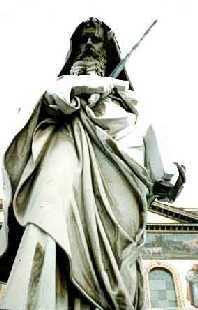
In the center of the piazza fronting the basilica stands a large statue of Saint Paul, sculpted by Giuseppe Obici.
Below the altar of the basilica lies a large sarcophagus and an ancient marble tombstone with the inscription: PAULO APOSTOLO MART / Paul the Apostle, Martyr.
The Chapel of the Relics contains the Chain that bound the Apostle Paul in the Mamertine Prison of Rome.
- Basilica di San Paolo alla Regola — Basilica of Saint Paul at the Rule (Regula region).
This is the only church dedicated to Saint Paul within the city of Rome itself.
It was constructed in the Jweish Quarter by Pope Sylvester in the 4th century on the spot where Saint Paul had written his epistles to the Colossians, to Philemon, to the Ephesians and to the Philippians.
The church is named for its environs, the Regola region of Rome, a Jewish sector across the Tiber River from Trastevere.
It is also home to the Farnese Palace and to a vibrant culinary scene in present Rome.
- San Paolo alle Tre Fontane — Saint Paul at the Three Fountains.
Here is the stuff that fables and traditions are made of.
There exists a story that when Saint Paul was decapitated, his head bounced three times and at each bounce a spring of water issued forth.
Good enough to name a region and a church!
Further, the fountain water is of three different temperatures: hot, warm, cold!
The first church on this presumed site of Paul's martyrdom was built in the 5th century.
It was rebuilt in 1599 as part of the Tre Fontane Trappist Abbey.
This church is south of the Rome city limits, near the EUR disctrict.
It boasts a marble column, said to be the one where Saint Paul was bound at his death.
June 29 each year is the Solemnity of Saints Peter and Paul, the two Prince Saints celebrated together for their heroic part in founding the Church in the Eternal City of Rome.
Here's some music that may help the festivities:
Article written 21 April 2026, the 2779th birthday of the City of Rome
|








 Back to Miscellaneous Index