








|
| Musical Musings: Miscellaneous |
Choirs of AngelsA Holy Hierarchy
There are traditionally nine orders of angels, called "choirs," affirmed by Pope Saint Gregory the Great. Five are mentioned by Saint Paul: Ephesians 1:20-21 says, "God showed strength in raising Christ from the dead and seating him at his right hand in heaven, high above every principality, power, virtue and domination." Colossians 1:16 reads "In God everything in heaven and on earth was created, things visible and invisible, whether thrones or dominations, principalities or powers, all were created through him, and for him." These represent the middle five orders of angels. Above them rank the seraphim, mentioned in Isaiah 6:1-7 "I saw the Lord seated on a high and lofty throne. Seraphim were stationed above; each of them had six wings. They cried one to the other, 'Holy, holy, holy is the Lord of hosts! All the earth is filled with his glory." And also there are the cherubim, from Ezekiel 10:4: "The glory of the Lord rose from over the cherubim to the threshold of the temple. The noise of the wings of the cherubim could be heard as far as the outer court, like the voice of God the Almighty." After these seven orders come the archangels and angels. The title archangel comes from I Thessalonians 4:16: "The Lord himself will come down from heaven at the word of command, at the sound of the archangel's voice and God's trumpet." Angels have multiple occurrences, most familiarly in Luke 2:9, with the Christmas shepherds: "The angel of the Lord appeared to them as the glory of the Lord shone around them." Let's examine this angelic hierarchy a little more closely. The nine choirs are divided into three orders, with three ranks in each. First Angelic OrderThese adore and contemplate God directly. Seraphim
In his Celestial Hierarchies, Dionysius the Areopagite writes: The name seraphim clearly indicates their ceaseless and eternal revolution about Divine Principles, their heat and keenness, the exuberance of their intense, perpetual, tireless activity, and their elevative and energetic assimilation of those below, kindling them and firing them to their own heat, and wholly purifying them by a burning and all-consuming flame; and by the unhidden, unquenchable, changeless, radiant and enlightening power, dispelling and destroying the shadows of darkness. Later, Saint Thomas Aquinas speaks of their nature: The name Seraphim does not come from charity only, but from the excess of charity, expressed by the word ardor or fire. Hence Dionysius (Coel. Hier. vii) expounds the name Seraphim according to the properties of fire, containing an excess of heat. Now in fire we may consider three things.
CherubimSecond in rank come the Cherubim, whose name means "fullness of wisdom." They are closely linked to God's glory, showing his power and mobility, with an intimate knowledge of the Almighty. They, like the Seraphim, offer continual praise at the Throne of God, contemplating His providence. The Cherubim have the likeness of a man, with four faces (man, lion, ox, eagle) and four wings, two covering their feet and two for flight. The Cherubim communicate the truth of God. Saint Thomas Aquinas disputed the notion that Lucifer belonged to the Seraphim, and placed him in the choir of Cherubim, since the burning love of Seraphim is opposite to pride, whereas great knowledge of truth, which the Cherubim possess, can more easily lead to pride. A tradition exists that the Cherubim guarded the Garden of Eden, protecting the Tree of Life. ThronesThrones represent the steadfast nature of God's love, and contemplate his power and judgment. There is a judicial aspect to their existence. Their description is most unique: flaming, rotating rings covered with eyes. Rosemary Ellen Guiley, an American spiritual author, writes: The thrones, also known as ophanim and galgallin, are creatures that function as the actual chariots of God driven by the cherubim. They are characterized by peace and submission; God rests upon them. Thrones are depicted as great wheels containing many eyes. They chant glorias to God and remain forever in his presence. They mete out divine justice and maintain the cosmic harmony of all universal laws. According to Catholic Online, thrones are known as "Angels of pure Humility, Peace and Submisssion. They reside in the area of the cosmos where material form begins to take shape. The lower Choirs of Angels need the Thrones to access God." Second Angelic OrderThese minister God's plan in the universe. Domininations
Dominations regulate the angelic duties, marking the commands of God. They are also known by the Greek term, kyriotetes, meaning "lordships." Virtues
Dr. Scherschligt: "God can run everything in the universe. He doesn't need angels or us. But God wants us to not only share in His divine life, he also wants us to have the delight of sharing in divine activity, divine work. And the more God gets his creatures involved in His plan, the more He delights and, frankly, the more we delight." They are also in charge of miracles and provide courage, grace, and valor. PowersPowers assist in governing the order of nature. These "warrior angels" are tasked with fighting the war against the demons and fighting against evil influences that oppose the virtues' providential plan. They are also known as potentates, and fight against evil spirits who attempt to wreak havoc on humanity. Dr. Scherschligt: "Saint Thomas Aquinas nicknamed the Angels, 'God's secondary causes' because God chooses to do many things in His creation through the intercession of His Angels." Third Angelic OrderThese interact and serve humanity. Principalities
The Principalities are leaders who direct the action of the Archangels and Angels in the spiritual battle on earth. Archangels
Archangels are special messengers responsible for effecting God's important plans for mankind.
Three are mentioned by name in the Bible: Michael appears as the great angelic general in the battle casting the demons from heaven. He holds a pre-eminent place among the archangels and angels, standing at the right hand of God. He defends the People of God in the final eschatological battle. Michael serves as High Priest in the heavenly sanctuary and accompanies the souls of the righteous into their divine eternity. As early as the sixth century, liturgical feasts honoring Saint Michael the Archangel existed. The Prayer to Saint Michael is commonly recited at the end of Mass:
Saint Michael the Archangel, defend us in battle. He is often depicted in art with battle attire: sword, shield and armor breastplate, and often slaying the serpent (Satan). Gabriel appears to Daniel to explain his visions. In the New Testament, Gabriel announces the birth of John the Baptist to Zechariah. He marks the beginning of the Christological age as the Angel of the Annunciation, announcing to the Blessed Virgin Mary the coming of the Son of God in his human form. A multitude of beautiful paintings show the Archangel Gabriel appearing to the Blessed Virgin Mary, often holding a lily, the symbol of purity. Folklore attributes Gabriel as the archangel who blows the trumpet signaling the end of the world. Raphael first appears in the Book of Tobit, with extended conversation. Later, he became identified as one of the three heavenly visitors entertained by Abraham at the Oak of Mamre. He is known as the Angel of Healing from his interaction with Tobias. Because of his association with healing, Raphael became identified with the unnamed angel of John 5:1-4 who periodically stirred the pool of Bethesda. He is the patron of the medical profession. AngelsThe lowest choir, the Angels, are closest to humanity and the material world. God's protection of man is frequently mentioned in the Bible, and its practical application is the teaching concerning our personal Guardian Angel, drawn from this lowest rank. The Catechism of the Catholic Church remarks: "Beside each believer stands an angel as protector and shepherd leading him to life." (CCC 336) According to Saint Jerome, the concept of guardian angels is in the "mind of the Church." He stated: "how great the dignity of the soul, since each one has from his birth an angel commissioned to guard it." Honorius, in the 12th century, said that every soul was assigned a guardian angel the moment it was put into a body. Saint Thomas Aquinas agreed with Honorius and believed that it was the lowest order of angels who served as guardians, and his view was most successful in popular thought. In the 15th century, the Feast of the Guardian Angels was added to the official calendar of Catholic feast days (October 2). The wit and wisdom of Pope Saint John XXIII: One day, a newly appointed bishop confessed to Pope John XXIII "that he could not sleep at night due to an anxiety which was caused by the responsibility of his office." The pope told him, "You know, I also thought the same when I was elected pope. But one day, I dreamed about my guardian angel, and he told me not to take everything so seriously." Pope John attributed the idea of calling Second Vatican Council to an inspiration from his guardian angel. Article written 04 June 2026 |
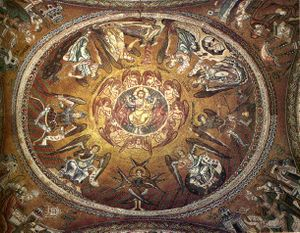 We know from Scripture and Revelation that angels are spiritual beings, created by God with intelligence and free will to do his bidding.
Early on, the fallen angels, led by Lucifer (whose name ironically means "Light Bearer," rebelled against God out of pride.
They were banished from heaven to the realms of the underworld, hell, where they oppose the Divine Holiness, scheming among themselves and vexing humanity in deceitful temptations to lure men from a relationship with their Creator.
The holy angels always maintained their affinity with God, inhabiting heaven and doing God's work throughout the universe.
We know from Scripture and Revelation that angels are spiritual beings, created by God with intelligence and free will to do his bidding.
Early on, the fallen angels, led by Lucifer (whose name ironically means "Light Bearer," rebelled against God out of pride.
They were banished from heaven to the realms of the underworld, hell, where they oppose the Divine Holiness, scheming among themselves and vexing humanity in deceitful temptations to lure men from a relationship with their Creator.
The holy angels always maintained their affinity with God, inhabiting heaven and doing God's work throughout the universe.
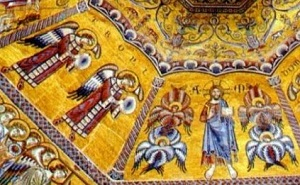 The highest rank of angels are the Seraphim, those closest to God.
The name means "burning ones," and they attend directly at the throne of the Almighty, afire with His immense love.
The Seraphim communicate the love of God.
We echo their exultant heavenly song at every Mass: "Holy, Holy, Holy is the Lord of Hosts!"
Detailed Scriptural descriptions show them to possess six wings, two to cover the face, two to cover the feet, two to fly.
Many believe that Lucifer belonged to the Seraphim, hence his might and power are very dangerous.
The highest rank of angels are the Seraphim, those closest to God.
The name means "burning ones," and they attend directly at the throne of the Almighty, afire with His immense love.
The Seraphim communicate the love of God.
We echo their exultant heavenly song at every Mass: "Holy, Holy, Holy is the Lord of Hosts!"
Detailed Scriptural descriptions show them to possess six wings, two to cover the face, two to cover the feet, two to fly.
Many believe that Lucifer belonged to the Seraphim, hence his might and power are very dangerous.
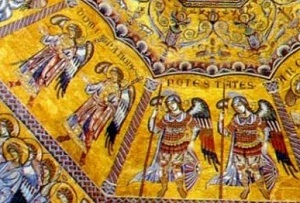 The highest rank of this second tier, Dominations, rule over the lower ranks and humanity, taking illumination from the choirs above and governing the universe.
Also known as "dominions," they exhibit authority over lower ranks — they are the angels of leadership.
According to Dr. Michael Scherschligt, "Their mission is to govern the material world, control the elements, the seasons, the stars, even the sun and moon — in short, all aspects of nature."
The highest rank of this second tier, Dominations, rule over the lower ranks and humanity, taking illumination from the choirs above and governing the universe.
Also known as "dominions," they exhibit authority over lower ranks — they are the angels of leadership.
According to Dr. Michael Scherschligt, "Their mission is to govern the material world, control the elements, the seasons, the stars, even the sun and moon — in short, all aspects of nature."
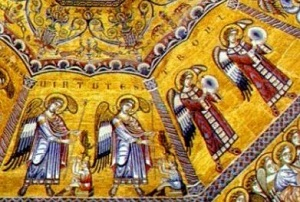 Virtues control movement in the universe, often associated with planets, elements, seasons, and nature.
"Virtue," in an older sense, meant power or energy.
They are also known as "the shining ones," and "the spirits of motions."
These are the first order to be sent by God to manifest themselves in the corporeal world.
Virtues control movement in the universe, often associated with planets, elements, seasons, and nature.
"Virtue," in an older sense, meant power or energy.
They are also known as "the shining ones," and "the spirits of motions."
These are the first order to be sent by God to manifest themselves in the corporeal world.
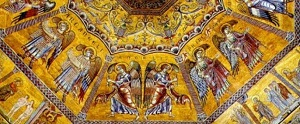 These Princes form the upper tier of the third order and care for and guard communities, kingdoms, states, and cities.
They are associated with transitions in power.
These Princes form the upper tier of the third order and care for and guard communities, kingdoms, states, and cities.
They are associated with transitions in power.
 Back to Miscellaneous Index
Submit Your Music / Contact Us / Company Description / Links