








|
| Musical Musings: Liturgy |
The Baptism of BellsThere is a glorious history of bells used in liturgy. This dates all the way back to the Jewish practice of attaching small golden bells to the lower hem of the high priest's robe, to announce his entrance into the holy place. Roman Catholic parishes use a variety of bells:
The first use of tower bells was by Saint Paulinus of Nola in Campania, Italy, in about 400 AD. Initially used to call monks to prayer from throughout the monastery, they eventually took the role of calling the faithful to Mass, starting in the 7th century. Solemn importance was placed on these tower bells, which functioned not only to honor God's holiness, but as a means of communication in the village, warning of imminent danger and pealing joyful celebrations. To properly "fit" the bells for these uses, an elaborate blessing ceremony developed in the 10th century, using sacramentals such as holy water and holy oils, often identified as the bell's "baptism." Here's how that impressive ceremony was structured. Preliminary RitesThe presiding bishop, in white cope and miter, is seated near the bell. The schola chants Psalms 51, 54, 57, 67, 70, 86 and 130. Blessing with Holy WaterWater is prepared and blessed, using the standard formula. Prior to the addition of salt, a special prayer is said: Bless, O Lord, this water with a heavenly benediction, and may the power of the Holy Spirit come upon it, so that when this vessel, prepared to call together the children of the Holy Church, has been washed with it, there may be kept far away from wheresoever this bell may sound, the power of those lying in wait, the shadow of spectres, the ravages of whirlwinds, the stroke of lightning, the damage of thunder, the disaster of tempests, and every breath of storm; and when the sons of Christians shall hear its ringing, may their devotion increase, so that hastening to the bosom of their loving mother the Church, they may sing to Thee, in the Church of the Saints, a new canticle, bringing therein to play the proud sounding of the trumpet, the melody of the harp, the sweetness of the organ, the joyous exultation of the drum, and the rejoicing of the cymbal; and so, in the holy temple of Thy glory by their service and their prayers, may they bid come the multitude of the angelic hosts. With aspergilum, the bishop sprinkles the bell inside and out, hence its "baptism." The assisting sacred ministers wash the entire bell. top to bottom, inside and out, with sponges. The bell is then dried with towels. During this, the bishop, seated, and clergy recite Psalms 145-150. AnointingThe bishop rises and marks a single Cross on the outside of the bell with Oil of the Infirm. Making the Sign of the Cross over that spot, he prays: O God, who through the blessed Moses, the law giver, Thy servant, didst command that silver trumpets should be made, through which when sounded by the priests at the time of sacrifice, the people, reminded by their sweet strains, would make ready to worship Thee, and assemble to offer sacrifices, and encouraged to battle by their sounding, would overcome the onslaughts of their enemies; grant, we beseech Thee, that this vessel, prepared for Thy Holy Church, may be sancti+fied by the Holy Spirit, so that, through its touch, the faithful may be invited to their reward. And when its melody shall sound in the ears of the peoples, may the devotion of their faith increase; may all the snares of the enemy, the crash of hail-storms and hurricanes, the violence of tempests be driven far away; may the deadly thunder be weakened, may the winds become salubrious, and be kept in check; may the right hand of Thy strength lay low the powers of the air, so that hearing this bell they may tremble and flee before the standard of the holy cross of Thy Son depicted upon it, to Whom every knee bows of those that are in Heaven, on earth, and under the earth, and every tongue confesses that the same our Lord Jesus Christ, swallowing up death upon the gibbet of the cross, reigneth in the glory of God the Father, with the same Father and the Holy Spirit, world without end. Amen. Wiping the oil from the bell with a towel, the bishop intones from Psalm 29, "The voice of the Lord is upon the waters; the God of majesty hath thundered, The Lord is upon many waters." The schola chants the remainder of the psalm. Meanwhile, the bishop makes seven crosses with Oil of the Infirm on the outside of the bell, and four crosses with Sacred Chrism on the inside. The crosses are each made twice, at the appropriate places in this prayer, with the Sign of the Cross thrice with his right hand during the Doxology: May this bell be sancti+fied and conse+crated, O Lord. In the name of the Fa+ther, and of the + Son, and of the Holy + Spirit. Unto the honor of Saint N. Peace to thee.
The dedicated name of the bell is pronounced at "Saint N." Let us pray. Almighty, Eternal God, Who, by the sounding of trumpets before the Ark of the Covenant, didst cause to tumble down the stone walls within which the army of the enemy was entrenched, do Thou pour out upon this bell a heavenly bene+diction, so that at its sound, the fiery darts of the enemy, the stroke of lightning, the hail-storm and the damage of tempests may be driven far away; and to the prophet's question, "What ailed thee, O sea, that thou didst flee?" (Psalm 114, 5) being driven back in their movements as was the river Jordan, they may give answer, "At the presence of the Lord, the earth was moved, at the presence of the God of Jacob, Who turned the rock into pools of water, and the stony hill into fountains of waters. Wherefore, not to us, O Lord, not to us, but to Thy name give glory, for Thy mercy's sake." (Ps. 114, 7-8; 115, 1) And thus when this vessel here present, like the other vessels of the altar, is touched with Holy Chrism, anointed with Holy Oil, may all those who assemble at its call be free from all the temptations of the enemy, and always follow the teachings of Catholic faith. IncensationAfter washing his hands, the bishop adds to the charcoal of a thurible or brazier a mixture of incense and myrrh called thymiama. The smoking incense is placed under the bell, such that the smoke rises into the bell cavity. The choir sings this antiphon, "Thy way, O God, is in the holy place: who is the great God like our God?" with the last five verses of Psalm 77. Then the bishop prays: Let us pray. Almighty Ruler, Christ, Who in the flesh, which Thou didst assume, were asleep in the boat, when the rising tempest disturbed the sea, which directly at Thy awakening and command did fall silent, come kindly to aid Thy people in their needs; pour out upon this bell the dew of Thy Holy Spirit, so that at its sound the enemy of the good may always flee, the Christian people may be invited to faith, the hostile army may be struck with terror; Thy people summoned together be comforted by it in the Lord, and, as if delighted with David's harp, may the Holy Spirit come down from above. And even while Samuel was sacrificing the suckling lamb as a holocaust to the King of the Eternal Empire, the noise of the rushing winds drove away the multitude of his adversaries: so in like manner, when the sound of this vessel pierces the clouds, may angelic hands preserve the assembly of Thy Church; may everlasting protection save the fruits of those who believe, their souls and their bodies. Through Thee, O Christ Jesus, Who with God the Father livest and reignest in the unity of the same Holy Spirit, God, world without end. Amen. GospelThe deacon solemnly sings a Gospel (Luke 10, 38-42), reminding all that like Saint Mary (contemplative) and Saint Martha (active), this bell will call the faithful to all activities occuring within the walls of the church. At that time, Jesus entered into a certain town: and a certain woman named Martha, received him into her house. And she had a sister called Mary, who sitting also at the Lord's feet, heard his word. But Martha was busy about much serving. She stood and said: "Lord, hast thou no care that my sister hath left me alone to serve? Speak to her therefore, that she help me." And the Lord, answering, said to her: "Martha, Martha, thou art careful, and art troubled about many things: But one thing is necessary. Mary hath chosen the best part, which shall not be taken away from her." The bishop makes a final Sign of the Cross over the bell and departs, ideally to some festive organ music!
Lest one think this elaborate ritual just a relic of the past, in May 2018, the church bell was thus "baptized" at Saint Barnabas Catholic Church in Omaha NE, a church of the Personal Ordinariate of the Chair of Saint Peter, by His Excellency Elden Curtiss, Archbishop Emeritus of Omaha. Article written 02 May 2026 |
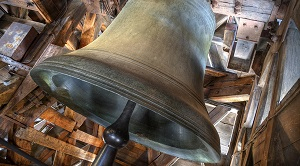 It is these last bells, hung in a tower, that are the topic of this article, and particularly their sometimes ornate blessing before use.
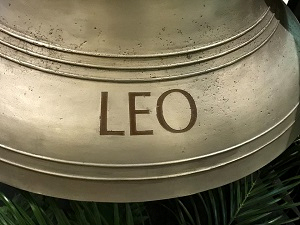 Tower bells are most often given names (usually of a saint or a title of the Blessed Virgin Mary).
This is inscribed on the outside of the bell, usually on the lower rim.
Tower bells are most often given names (usually of a saint or a title of the Blessed Virgin Mary).
This is inscribed on the outside of the bell, usually on the lower rim.
 Back to Liturgy Index
Submit Your Music / Contact Us / Company Description / Links