








|
| Musical Musings: Holy Week |
Palm Sunday — or not?
"Cloaks" are mentioned more often than palms — but "Cloak Sunday" doesn't seem to cut it. The branches in Matthew could easily have been palms. While palms represent victory (even in Greek times), triumph and peace, the reeds of Saint Mark call forth mercy and justice, hearkening to Isaiah, "A bruised reed He will not break." The cloaks mentioned in the three synoptic Gospels are a symbol of one's identity, one's vital personal possession. Laying them before the Messiah represents a surrender of one's self before the arrival of the king. Prior to the Passover, the Roman prefect, Pontius Pilate, would have entered the city of Jerusalem from the west by chariot. Accompanied by legions on horseback, he would have been hailed as the presence of Imperial Rome in the region. Jesus' entrance from the east, pre-arranged by himself to inaugurate his Passion, was a more humble affair. There would have been exuberant festivity in the Roman ritual, but Christ's followers also cried out, such that "Even the stones shall sing." The Gospels mark the chanting of the crowds in similar ways:
The word "Hosanna," used so frequently, is a Hebrew word meaning "save us." It has roots in the Jewish festival of Sukkot, the Feast of Booths, where it forms part of the morning prayer, sung each of the seven days, as "Hoshana." This was shouted as a cry of joy and praise during Christ's Entry into Jerusalem, acclaiming the Messiah as the true one who "Saves Us." Palm Sunday, officially known as Palm Sunday of the Lord's Passion, is celebrated on the Sunday before Easter. The Passion narrative is proclaimed as the Gospel, according to the pattern;
The Passion according to Saint John is read every year on Good Friday. In addtion to the Passion, a Gospel selection by the same evangelist is read at the beginning of Mass, prior to the Blessing of Palms in the Procession or Solemn Entrance. Whether palms, reeds, or just cloaks were used, we take great delight in receiving the blessed palms distributed in this most popular Mass. Often they wind up woven into simple crosses or extravagant decorations. These, or the straight palm branch, are taken home and placed behind crucifixes and other devotional artwork. Article written 10 March 2026
See also:
|
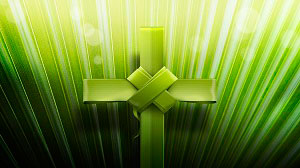 Of the four Gospels, only Saint John refers specifically to palms during the Triumphal Entry of Christ into Jerusalem:
 Back to Holy Week Index
Submit Your Music / Contact Us / Company Description / Links